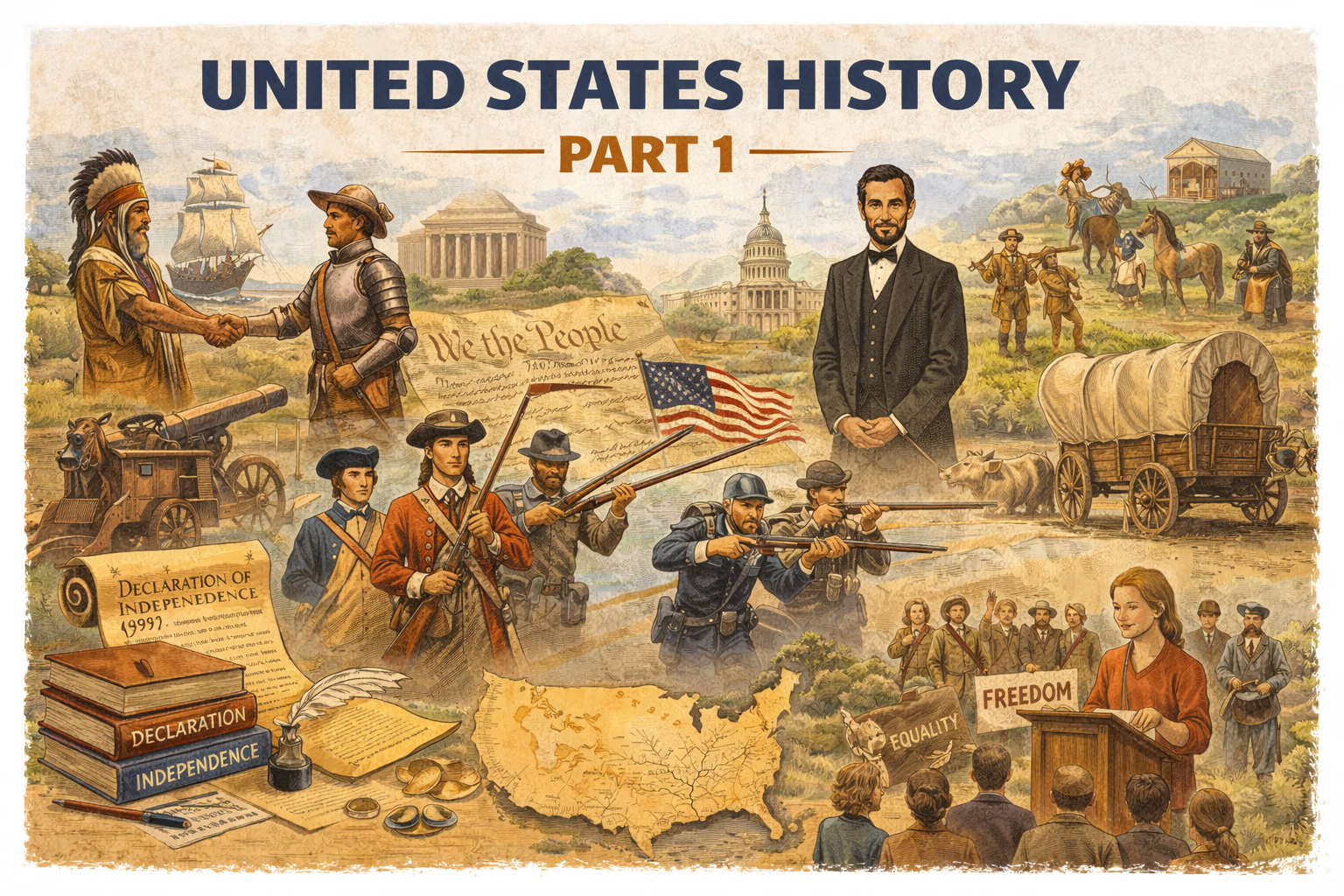
This course explores the history of the United States from 1491 to 1877 by analyzing key people, events, and ideas that shaped the nation’s early development. They will examine topics such as European exploration and migration, the American Revolution and Constitution, the Jeffersonian and Jacksonian eras, antebellum reform movements, the Civil War and Reconstruction, and westward expansion. Throughout the course, students will develop historical thinking skills, construct evidence-based arguments, apply historical reasoning processes, and evaluate how the United States has upheld its founding ideals. Additionally, students will practice essay writing and source analysis. This is the first course in a two-part series that prepares students to take the AP United States History exam.
What You’ll Learn
- Early U.S. Foundations (1491–1877): Trace the development of America from pre-Columbian times through Reconstruction.
- Key Eras & Turning Points: Examine European exploration, colonial America, the Revolution, the Constitution, the Jacksonian era, antebellum reform, Civil War, and Reconstruction.
- Historical Thinking & Argumentation: Build skills in interpreting primary sources, crafting evidence-based arguments, and analyzing turning points in U.S. history
- Credit Hours: 0.5
Course Features
- Lecture 0
- Quiz 0
- Duration 10 weeks
- Skill level All levels
- Language English
- Students 0
- Assessments Yes
- 15 Sections
- 0 Lessons
- 10 Weeks
- Module 1: Native Americans and European Exploration0
- Module 2: Columbian Exchange and Colonial Footholds0
- Module 3: Colonization0
- Module 4: Colonial Society and Identity0
- Module 5: The American Revolution0
- Module 6: Document-Based Questions0
- Module 7: A New Nation0
- Module 8: A Young Country0
- Module 9: Midcourse Quiz0
- Module 10: A Developing Republic0
- Module 11: Transformation of the Political Landscape0
- Module 12: Leading up to a Civil War0
- Module 13: The Civil War0
- Module 14: Reconstruction0
- Module 15: Review0