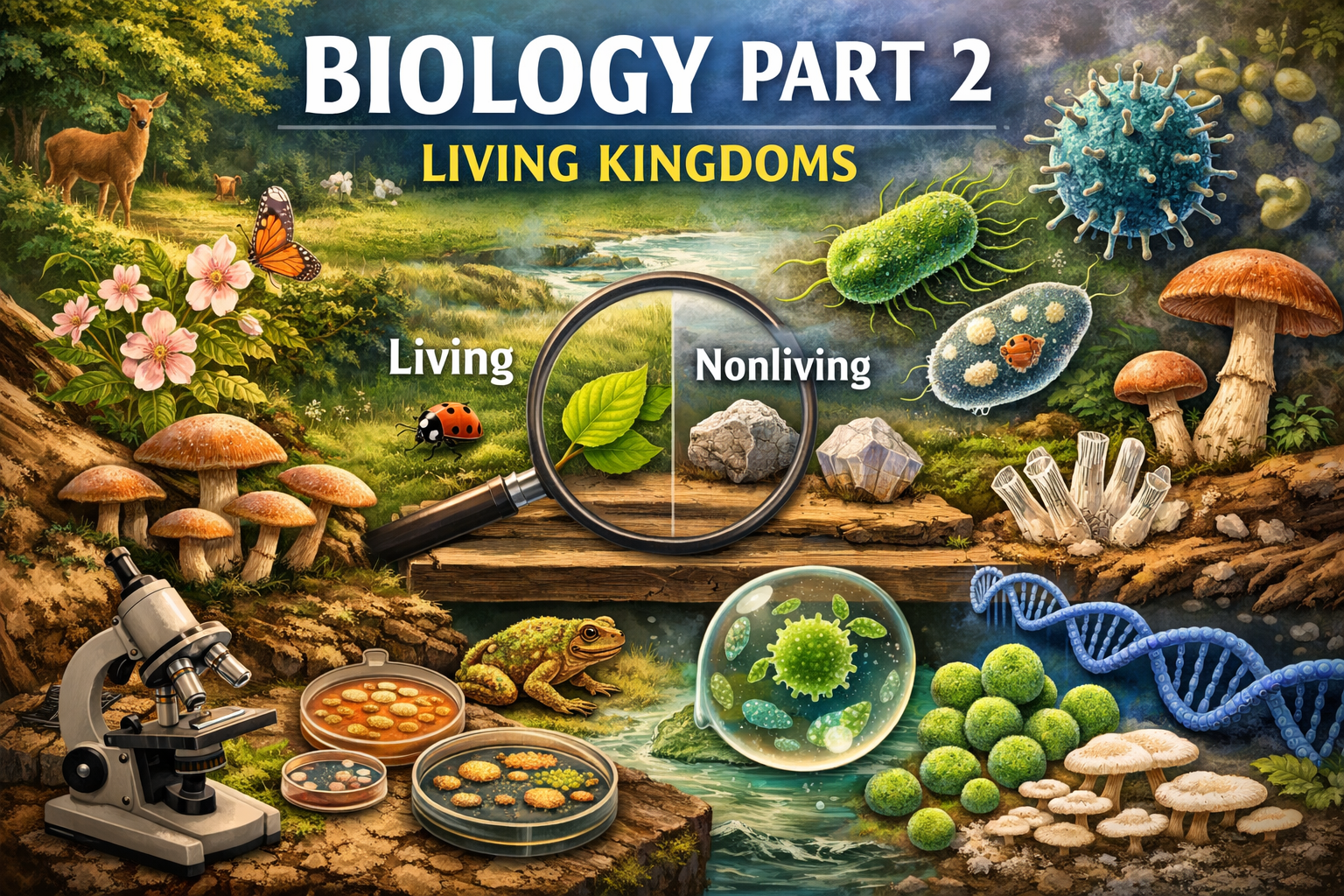
In this course, students will continue studying life but with a progressively wider lens by discovering the variety of life that has evolved, determining how to categorize different living things and comparing how these living things interact with their environment. This is the second course in a two-part Biology series. This course also encompasses Next Generation Science Standards (NGSS).
This course uses Knowledge, Skills, and Attributes (KSA) model to give students the opportunity to develop both real-world 21st Century Skills and Social and Emotional Learning Soft Skills to develop college and career readiness.
- Knowledge: Biology, Part 2
- Skill: Critical Thinking—Design Thinking
- Attribute: Responsibility
What You’ll Learn
- Living Kingdoms: Distinguish among the six kingdoms of living things, compare living and nonliving characteristics, and explore the roles of viruses, bacteria, fungi, and protists.
- Plants & Their Processes: Explain the importance of plants, understand the discovery of photosynthesis, and compare the structures and functions of roots, stems, and leaves.
- Animals & Human Systems: Describe invertebrates and vertebrates, compare the five vertebrate classes, classify mammals into their major groups, and identify the eleven human body systems and their functions.
- Credit Hours: 0.5
Notes
This course takes a minimum of 8 weeks to complete, as there are experience activities in the course that cannot be completed in less time.
Prerequisites
Course Features
- Lecture 0
- Quiz 0
- Duration Lifetime access
- Skill level All levels
- Language English
- Students 0
- Assessments Yes
- 15 Sections
- 0 Lessons
- Lifetime
- Module 1: Genetic Patterns—Genetics, Part 10
- Module 2: Genetic Patterns—Genetics, Part 20
- Module 3: Genetic Patterns—Inheritance and Variation of Traits, Part 10
- Module 4: Genetic Patterns—Inheritance and Variation of Traits, Part 20
- Module 5: Genetic Patterns—Biotechnology0
- Module 6: Evolutionary Change—Evolution through Natural Selection, Part 10
- Module 7: Evolutionary Change—Evolution through Natural Selection, Part 20
- Module 8: Evolutionary Change—Changes in Species Over Time, Part 10
- Module 9: Evolutionary Change—Changes in Species Over Time, Part 20
- Module 10: Evolutionary Change—Systems of Organization, Part 10
- Module 11: Evolutionary Change—Systems of Organization, Part 20
- Module 12: Evolutionary Change—Systems of Organization, Part 30
- Module 13: Interactions with Organisms and Environment—Ecosystems, Part 10
- Module 14: Interactions with Organisms and Environment—Ecosystems, Part 20
- Module 15: Final Report0