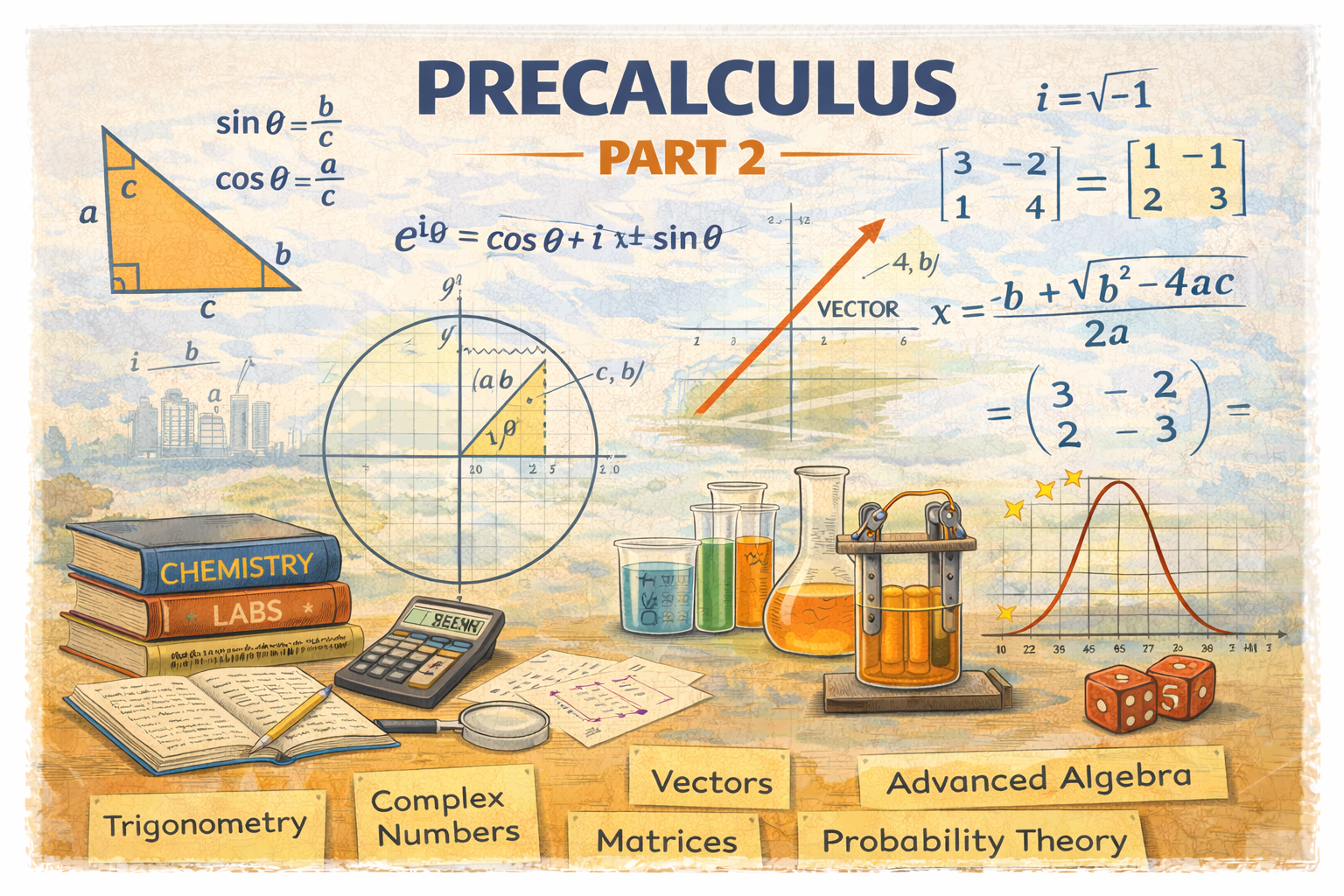
This course is designed to further introduce students to the foundational principles necessary for success in calculus courses, as well as to foster math inquiry and problem-solving skills. It is a study of trigonometry, complex numbers, vectors, matrices, advanced algebra, and probability theory. This is the second course in a two-part Precalculus series.
This course uses our Knowledge, Skills, and Attributes (KSA) model to give students the opportunity to develop both real-world 21st Century Skills and Social and Emotional Learning Soft Skills to develop college and career readiness.
- Knowledge: Precalculus, Part 2
- Skill: Communication—Communicate Using Writing
- Attribute: Diligence
What You’ll Learn
- Trigonometric Identities & Functions: Study fundamental trigonometric identities and their applications.
- Vectors & Matrices: Explore vector operations and matrix applications in solving systems of equations.
- Conic Sections & Sequences: Analyze conic sections and understand arithmetic and geometric sequences.
- Probability Theory: Investigate basic principles of probability and their real-world applications.
- Credit Hours: 0.5
Prerequisites
Precalculus, Part 1 (PRECALC-041) or equivalent
This course is part of our High School Program (Grades 11) bundle.
Course Features
- Lecture 0
- Quiz 0
- Duration Lifetime access
- Skill level All levels
- Language English
- Students 0
- Assessments Yes
- 15 Sections
- 0 Lessons
- Lifetime
Expand all sectionsCollapse all sections
- Module 1: Trigonometric Identities0
- Module 2: Trigonometric Formulas0
- Module 3: Sinusoidal Functions and Law of Sines0
- Module 4: Law of Cosines, Heron's Formula, and Polar Coordinates0
- Module 5: Polar Coordinates, Continued0
- Module 6: Parametric Equations0
- Module 7: Vectors and Systems of Equations0
- Module 8: Midcourse Exam0
- Module 9: Systems of Linear Equations Continued and Partial Fractions0
- Module 10: More Partial Fractions and Matrices0
- Module 11: Using Matrices to Solve Systems of Linear Equations0
- Module 12: Conics0
- Module 13: Conics and Sequences0
- Module 14: Arithmetic and Geometric Sequences0
- Module 15: Counting and Probability0