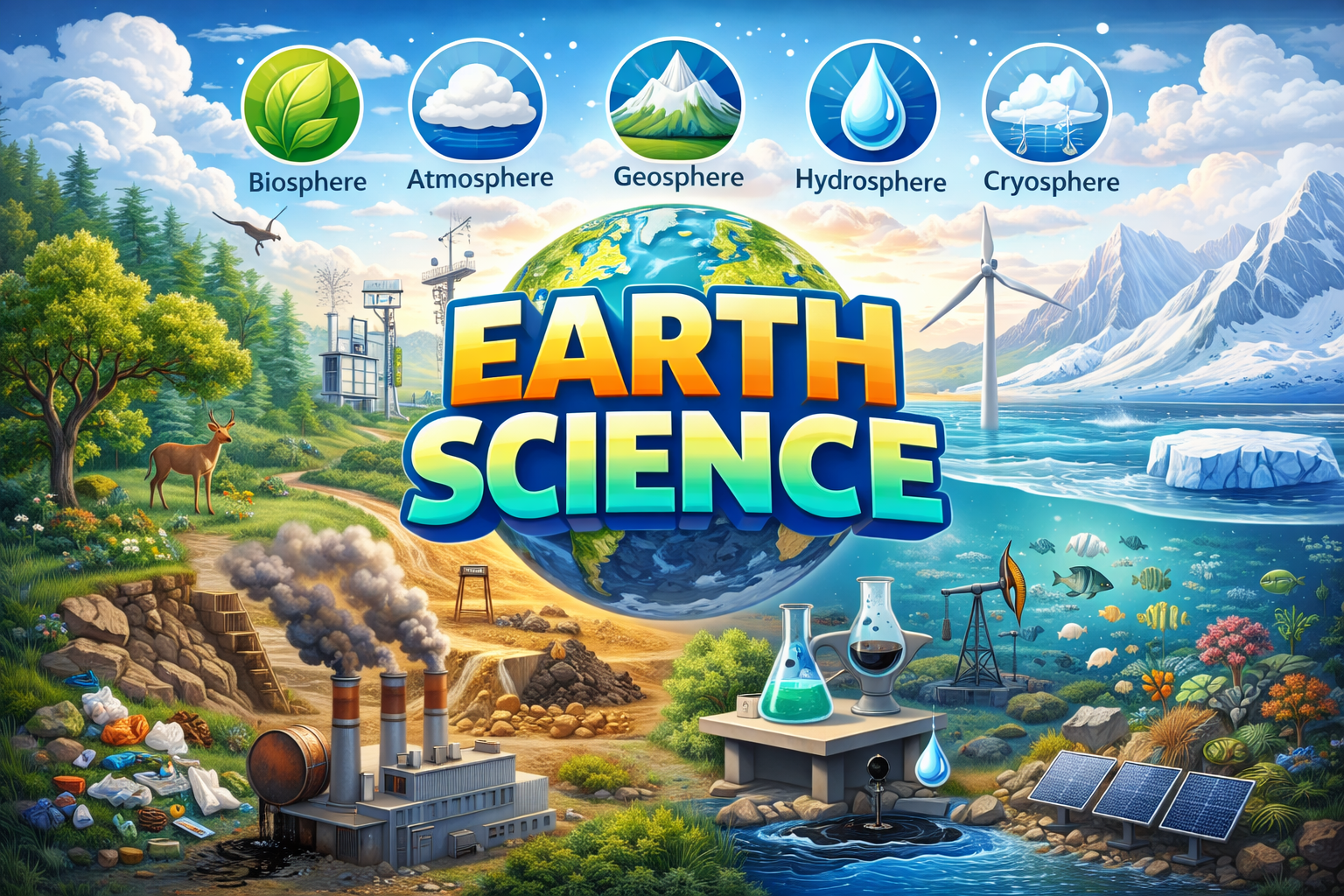
This course takes a look at the resources that populate the spheres (biosphere, atmosphere, geosphere, hydrosphere, and cryosphere) and how we use, renew, deplete, and waste them. Students will learn about experimental design, properties of water, weathering and erosion, oceans, the atmosphere, Earth’s climate, feedback loops, natural resources, pollution, and sustainability. This is the second half of a two-part Earth Science series. This course also encompasses Next Generation Science Standards (NGSS).
This course uses Knowledge, Skills, and Attributes (KSA) model to give students the opportunity to develop both real-world 21st Century Skills and Social and Emotional Learning Soft Skills to develop college and career readiness.
- Knowledge: Earth Science, Part 2
- Skill: Communication—Deliver Presentations
- Attribute: Respect
What You’ll Learn
- Space: Learn about our solar system, the Big Bang, stars, and the formation of the elements.
- Life: Examine the conditions for life on Earth and how energy moves through living organisms.
- Biodiversity: Study Earth’s biomes and how humans can help maintain biodiversity and prevent extinctions.
- Credit Hours: 0.5
Prerequisites
Earth Science, Part 1 (Earth 041) or equivalent
Course Features
- Lecture 0
- Quiz 0
- Duration Lifetime access
- Skill level All levels
- Language English
- Students 0
- Assessments Yes
- 15 Sections
- 0 Lessons
- Lifetime
- Module 1: Introduction—The Nature of Science0
- Module 2: System Interactions—Properties of Water0
- Module 3: System Interactions—Weathering and Erosion0
- Module 4: System Interactions—Ocean Processes0
- Module 5: System Interactions—Earth's Atmosphere0
- Module 6: System Interactions—Climate and Weather0
- Module 7: System Interactions—The Carbon Cycle0
- Module 8: System Interactions—History of Earth's Climate0
- Module 9: Stability and Change—Feedback Loops0
- Module 10: Stability and Change—Future Predictions0
- Module 11: Stability and Change—Natural Resources0
- Module 12: Stability and Change—Human Impact0
- Module 13: Stability and Change—Sustainability0
- Module 14: Stability and Change—Pollution0
- Module 15: Stability and Change—Environmental Problems0